From Painted Backdrop to Designed Screen World
See how painted backdrops differ from integrated screen worlds, and learn to read the sets, light, depth, and details that make a film’s setting feel coherent.
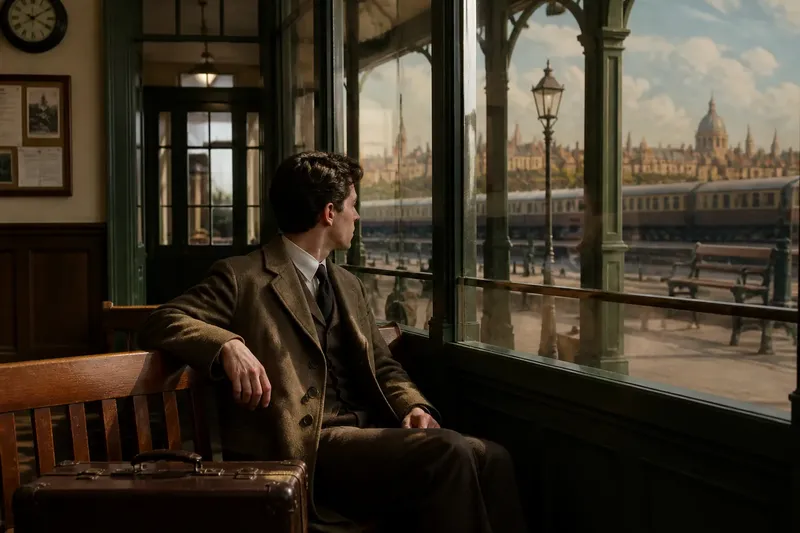
A painted skyline can sit behind an actor like a theatrical curtain, while a newer film may make its distant city, nearby street, and cramped room feel like parts of one place. To understand a designed screen world, begin by noticing what the camera asks you to accept: a flat image, a suggestive stage, or an environment whose pieces appear to belong together.
The shift from painted backdrop to designed screen world is not a simple march from “fake” to “real.” Older methods could be expressive and deliberate; contemporary films can still use painted scenery, miniatures, or studio walls. The useful distinction is how each element participates in the scene’s space and storytelling.
Start by identifying what the backdrop needs to do
In a traditional theatrical arrangement, a painted drop often supplies a legible location at a glance: a palace, forest, or distant city. It may provide atmosphere and a visual cue without behaving like a place the actors can enter. The design is built to read from the audience’s fixed viewpoint, and its painted perspective can help suggest depth from that position.
Film changes the terms because the camera can move, cut, and select details. A background that looks convincing in a wide composition may feel thin in a close-up or from a shifted angle. So when you watch a scene, ask whether the setting is primarily an image behind the action or a space the action appears to inhabit.
Look first at the actors’ relationship to the scenery. Do they cross in front of it, touch objects that seem to continue into it, or pass through a doorway that leads to another visible area? These interactions offer clues about the kind of world the production is asking you to imagine.
Read the frame for signs of depth
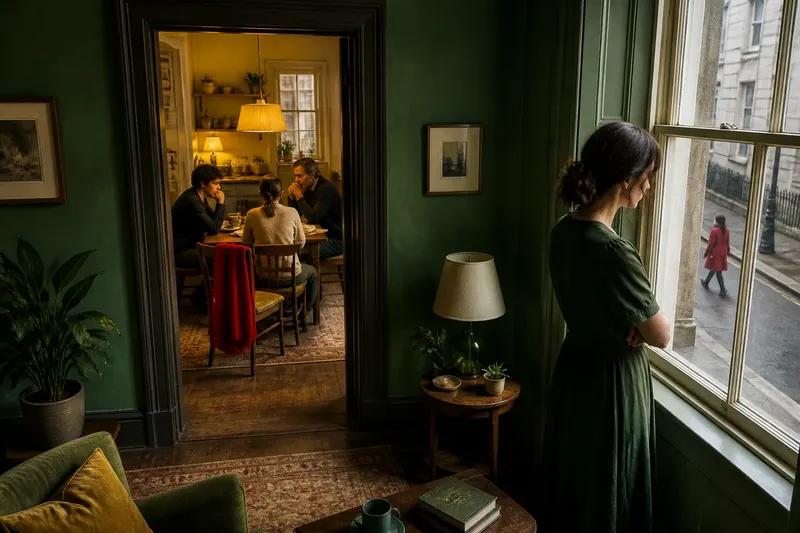
A designed environment often builds depth through several layers rather than relying on one distant picture. The foreground may contain a table edge or doorway; the middle ground holds the actors; beyond them, a corridor, window, or street draws the eye farther into the frame. Those layers need not be physically continuous, but their visual relationships can make the scene feel connected.
Check whether lines and surfaces point toward a plausible space. A road narrowing toward a painted horizon can work beautifully in a locked-off composition. If the camera travels past the road, however, the scene may need additional set pieces, a miniature, projection, or digital imagery to preserve the illusion from the changing viewpoint.
Lighting is another clue. A painted vista may carry its own depicted sunlight, while the performers and foreground receive studio lighting. That contrast can be an intentional theatrical effect. In a more integrated design, the apparent direction, softness, and color of light tend to make the foreground and background feel as though they share a common atmosphere.
Think of the frame like a room seen through a doorway: the view feels continuous when the surfaces, light, and perspective agree, even if you cannot see every wall. The analogy is about visual coherence, not proof that the entire setting exists as one built space.
Notice how the camera changes the design’s demands
A backdrop designed for a stationary camera can be striking because it concentrates attention. Its limitations may become part of the style, much as a stage production uses a visible flat to invite the audience into an imaginative bargain. Rather than asking whether the image could fool someone at every angle, consider whether it serves the scene’s chosen composition.
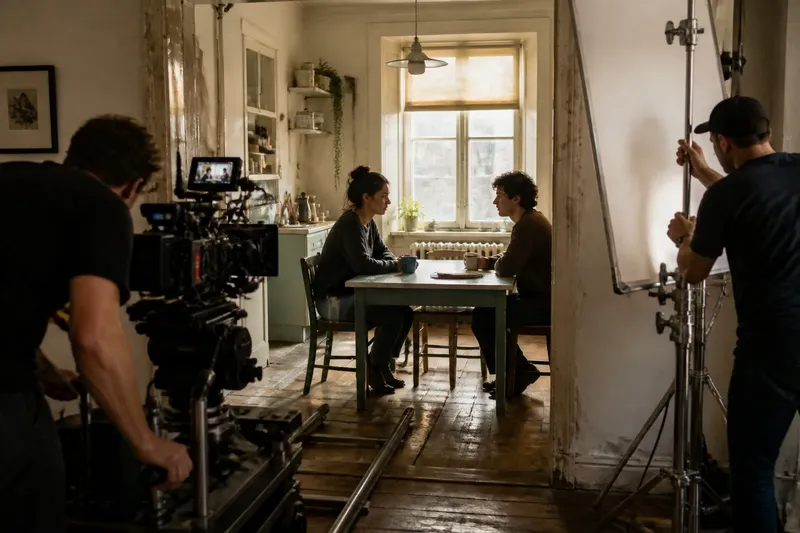
Camera movement makes that bargain more complicated. A tracking shot can reveal the edge of a flat, demand a deeper set, or motivate a transition between constructed and projected elements. A cut to a close-up may ask the art department to provide a convincing surface at hand level, while a wide shot may depend on a distant painted or digital extension.
Sound and blocking also shape the perceived world. Footsteps that echo in a hallway, a character glancing toward activity beyond a window, or a door opening onto a new slice of space can suggest continuity beyond what the frame shows. The environment becomes persuasive through what the film lets you infer, not only through how much scenery it displays.
Follow materials and details across the scene
To read a screen world closely, track a few visible materials: brick, glass, fabric, painted wood, or metal. Do their texture and finish change abruptly between the actor’s surroundings and the distant background? A sharp difference can reveal separate techniques, while repeated colors or surface patterns may connect elements made by different means.
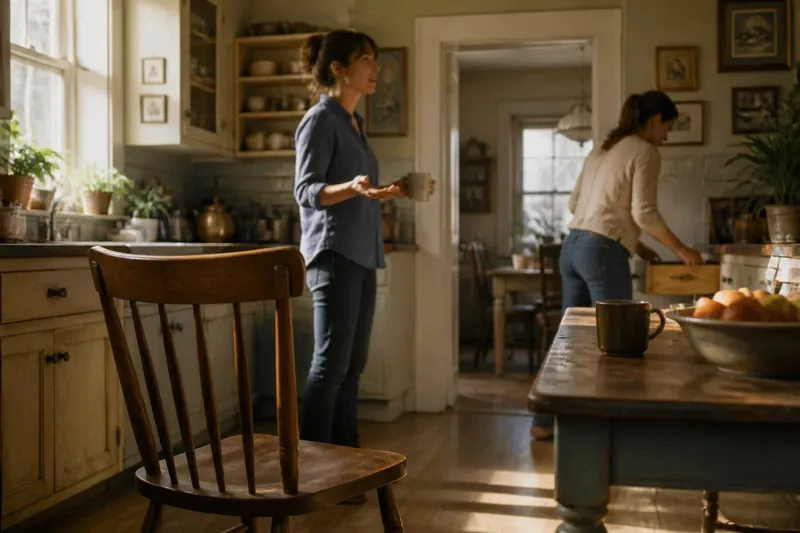
Details can also tell you whether the environment has a point of view. A spotless corridor, a crowded shopfront, or a window crowded with plants does more than establish a location; it suggests who maintains the place and what kinds of lives might continue outside the scene. In a designed world, these details can make setting feel inhabited without demanding an explanatory line of dialogue.
Imagine a fictional scene in a railway waiting room. The starting image is an actor beside a painted platform view; the filmmaker then adds a practical bench, a glass partition, and matching reflections in the window, while keeping the painted distance for the locked-off wide shot. You would expect the space to feel more connected during the actor’s interaction with the bench and glass, while the distant picture remains a clearly composed view rather than a place the camera can freely explore.
Compare the approaches without ranking them
Painted backdrops, practical sets, location work, miniatures, rear projection, and digital extensions each offer different kinds of control. A painted drop can condense a landscape into a strong graphic image. A practical set gives performers surfaces and objects to engage with. A location brings existing textures and irregularities, while miniatures or digital work can extend a world beyond what could be built or filmed in one place.
Many films combine these methods. The important question is not which technique appears, but whether the film’s choices support its intended style and the camera’s viewpoint. A visibly artificial background may create distance, fantasy, or a theatrical mood; a carefully blended environment may encourage the audience to treat several constructed pieces as a continuous place.
When the production uses green screen or digital compositing, the same visual questions still apply. Do the actor’s light, the apparent distance, and the background’s perspective agree? Does the frame give you a reason to accept the space, or does it draw attention to the join between elements? Those are observations about the image, not a reliable way to identify every technique behind it.
How can you tell what kind of world a film is building?
What makes a painted backdrop feel theatrical?
It often presents a complete view from a preferred angle, with little apparent depth beyond the image. That can be a purposeful visual language, especially when performers and scenery are arranged like a stage picture.
Does a modern screen world have to look realistic?
No. A world can feel integrated while remaining stylized, fantastical, or deliberately artificial. Consistent perspective, lighting, materials, and spatial cues matter more than resemblance to an everyday location.
Why do some backgrounds look convincing in one shot but not another?
Each composition places different demands on the scenery. A backdrop may work in a fixed wide view but feel less convincing after a close-up, camera move, or change in the actors’ position.
Can a film combine painted scenery with digital extensions?
Yes. A production can use physical scenery for the performers and extend the view through painted, projected, miniature, or digital elements. The combination can remain legible as a mixture of techniques while still reading as one designed environment.
Use a simple viewing routine to read the setting
On your next viewing, choose one scene and follow its space in order. Start with the widest frame, then watch how the camera moves, where the performers touch or cross the set, and whether lighting and materials continue into the distance. Finish by asking what the background contributes: location, mood, scale, character, or a deliberate sense of theatrical display.
- Find the scene’s clearest wide view and note where the foreground ends.
- Watch for a doorway, window, or corridor that implies space beyond the main action.
- Compare the light on the actors with the light suggested in the background.
- Track one material or color as the camera changes position.
- Notice whether the actors interact with the setting or simply perform in front of it.
- Decide whether visible artificiality supports the scene’s mood or interrupts its spatial logic.
This routine keeps the question specific: not “Is the set real?” but “How does the film make this place work for this shot?” A backdrop can remain a picture and still be expressive; an integrated screen world can combine many separate techniques without pretending they were all built on one stage.
The next time a distant skyline appears behind a character, look for the small choices that connect it to the foreground: a shared direction of light, a window reflection, or a movement that carries your attention beyond the actor. Those details help explain how a painted backdrop can become part of a larger screen world without losing the visual clarity that made it effective in the first place.