The Empty Chair That Gives a Room Its Shape
An empty chair in film composition can steer attention and suggest relationships; learn how placement, framing, and character movement shape its effect.
An empty chair in a film scene can pull your eye before anyone sits down. In film composition, its position beside a doorway, at the end of a table, or just outside a character’s reach can organize the room and hint at a relationship without spelling one out.
The chair does not carry a fixed meaning. It might suggest an absent person, a place being offered, a seat no one wants, or simply the room’s most useful piece of furniture. Its effect comes from how the camera and performers treat it. Three approaches—making the chair a visual anchor, a gap between people, or a destination for movement—give filmmakers distinct ways to shape a scene.
Use the chair as a visual anchor
A chair can steady a composition when the rest of the frame feels busy. Set near the foreground or against a clear patch of wall, it gives the viewer a recognizable point to return to while actors cross the room or shift in conversation. The empty seat becomes part of the scene’s visual grammar, not a symbol the audience must decode.
This approach suits scenes with several competing details: a crowded kitchen, a cluttered office, or a parlor full of framed pictures. The chair can hold a quiet patch of negative space, keeping the frame legible without requiring an extra close-up. Its shape works a little like a comma on a page: it gives the eye a pause while the rest of the sentence continues.
Placement matters. A chair aimed toward the camera reads differently from one turned toward a window or pulled away from a desk. A slight angle can connect it to a character’s eyeline, while a squared, isolated position can make it feel deliberately presented. These are invitations to look, not instructions for what to conclude.
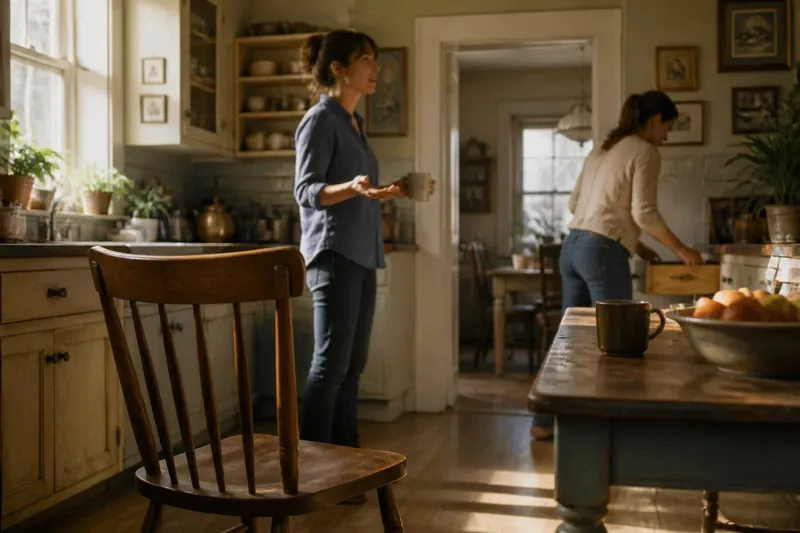
Imagine a fictional scene in a busy family kitchen, where one character talks while another searches a drawer. The director places an empty wooden chair in the foreground, its back partly framing the speaker; as the searching character moves, the chair remains still and visible. The expected effect is that viewers can track the conversation through the room’s activity, with the seat acting as a stable visual reference rather than a coded message.
Place the chair between people
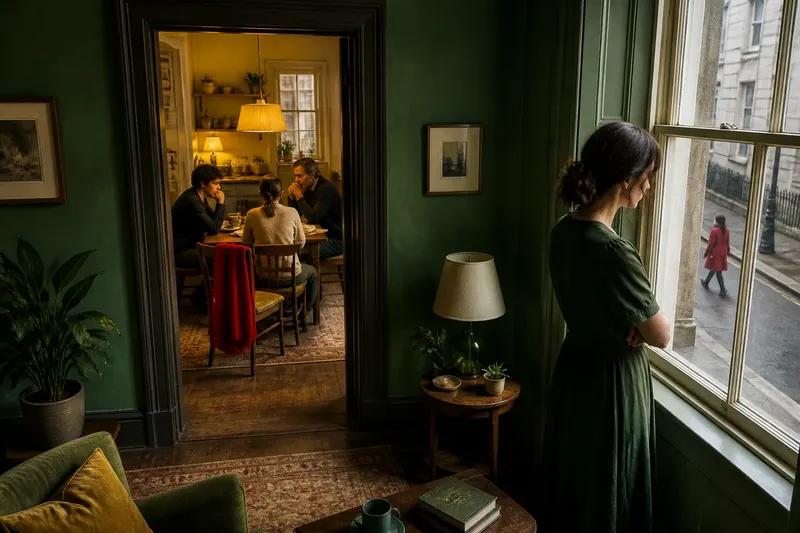
A chair can also define a relationship by occupying the space between characters. Put it between two people at a table, and it may interrupt their shared line of sight. Leave a seat open beside one character while another stands across the room, and the distance becomes part of the blocking.
This approach suits dialogue scenes where closeness, avoidance, or uncertainty matters more than a busy setting. The chair gives actors a physical object to orient around: one may rest a hand on its back, while another refuses to look at it. The frame then shows a relationship through distances and gestures, without forcing the dialogue to explain every tension.
Still, the empty seat should not be treated as a universal emblem of grief or rejection. A family may leave a chair open because someone is late; a host may pull one out as a welcome; a character may simply need space to move. The scene’s other cues—performance, camera distance, sound, and what happened just before—shape which reading feels plausible.
For this method, decide whether the chair should connect the characters or divide them. A seat aligned with both may make the gap feel shareable; one turned away or placed off-axis can sharpen separation. Keep the staging readable enough that viewers notice the distance, but let their interpretation remain open.
Make the chair a destination for movement
Instead of holding the chair in a fixed composition, a scene can make it the place a character approaches, avoids, or leaves behind. That movement gives the furniture a changing role: the seat may begin as a background detail and become important when someone hesitates beside it.
This approach suits scenes built around a decision or a shift in who controls the room. A character who circles the chair without sitting creates a different impression from one who claims it while another remains standing. The action makes the relationship observable, while the chair’s meaning remains tied to this particular moment.
Blocking should give the movement a clear beginning and end. If an actor crosses to the chair, pauses, then turns away, the audience can follow that choice. If the seat is hidden by other performers or furniture, the movement may read as ordinary traffic rather than a decision. The director can adjust the camera’s framing or leave a clean route through the set so the action stays visible.
Choose this method when the scene needs a change in status or intention to happen in the room, rather than only in a line of dialogue. A chair approached but not taken can sustain uncertainty; a seat occupied after another character leaves can make a shift in access feel plain. Neither effect requires the chair to stand for a person or an idea.
Which empty-chair approach fits the scene?
When should the chair anchor the frame?
Use it as an anchor when the room contains visual clutter or several moving characters, and the audience needs a steady point. Keep the chair visible without making it dominate the action.
When should it sit between characters?
Place it between performers when the scene depends on distance, awkwardness, invitation, or an unspoken boundary. Let their eyelines and gestures establish the relationship rather than relying on the chair alone.
When should a character move toward it?
Make the chair a destination when approaching, taking, or avoiding a seat is part of the scene’s action. The movement should change what the viewer understands about the characters’ choices or access to the room.
Can the same chair suggest different things?
Yes. Its effect can change with the camera angle, who is present, and what a character does nearby. Preserve that flexibility by treating the chair as part of the composition, not as a symbol with a preset definition.
Choose one job for the chair
Before setting the frame, ask what the empty seat needs to do: steady the image, organize the space between people, or give a character a visible destination. Pick the approach that serves the scene’s action, then remove competing business that makes the chair hard to read.
For film composition, a useful check is to watch the scene without sound and notice where your attention goes. If the chair draws the eye at the right moment, its placement is working; if it distracts from a crucial gesture, move it, turn it, or let it recede. The most expressive empty chair is often the one whose presence feels natural while its position quietly shapes how the room is seen.